Education · Terroir
How Georgia’s Regions
Shape What’s in the Glass
Eastbound Advisory · 7 min read
 Written by Nick Russell
Eastbound Advisory · 7 min read
Written by Nick Russell
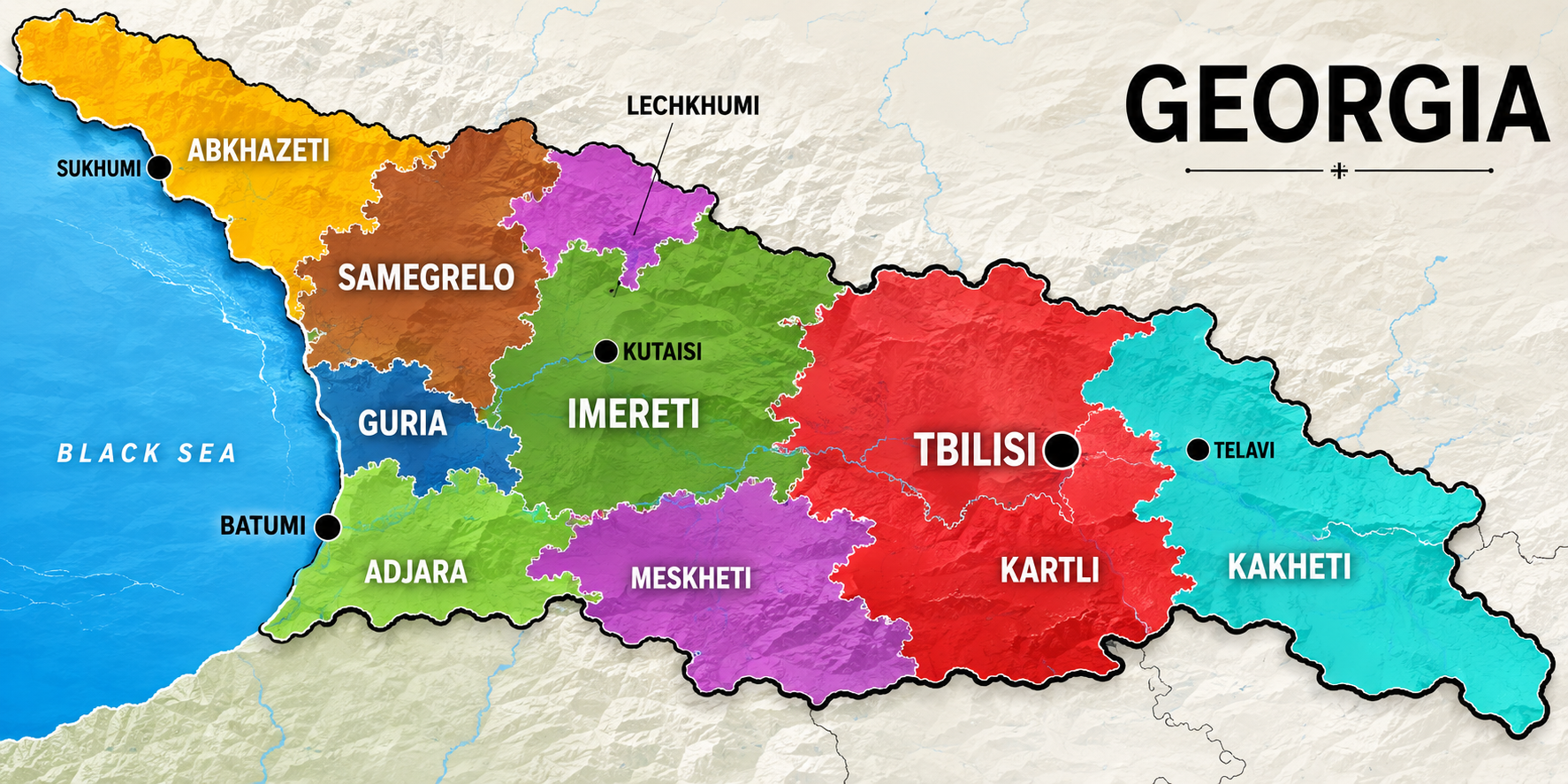
Georgia is a small country — smaller than South Carolina — but its wine regions are dramatically different from one another. Climate, elevation, and soil shift fast across short distances, and the wine changes with them.
Kakheti in eastern Georgia has a continental climate — hot summers, cold winters, and wide temperature swings between day and night that build sugar and acidity in the same grape. This is the heartland of amber winemaking and the source of Georgia's most structured, age-worthy wines. The Alazani Valley's alluvial soils support both Saperavi's depth and Rkatsiteli's long qvevri maceration tradition.
Western Georgia is cooler and more humid than Kakheti. Imereti producers still work in qvevri, but typically use shorter skin contact than their eastern counterparts, resulting in lighter, fresher amber wines with a distinct regional character — less tannic grip, more brightness.
High in the mountains of the northwest, short growing seasons and cooler temperatures mean lower yields and grapes that struggle to fully ferment dry — which is exactly how the region's famous semi-sweet reds occur naturally. Production here is small almost by necessity, which is part of why Racha wines are some of the rarest in the country.
Central Georgia, around Tbilisi, sits at higher elevation with cooler conditions than Kakheti. The result is lighter-bodied reds like Tavkveri and crisp whites, and Kartli has also become a center for producers blending traditional qvevri methods with more modern, European-influenced winemaking.
Georgia's Black Sea coast is subtropical and humid — a sharp departure from the rest of the country's wine geography. Grapes like Chkhaveri have adapted to conditions unlike anywhere else in Georgia, and the region remains a small, largely experimental corner of the industry.
For an importer, region is not trivia — it is the story that explains why one Georgian producer's wine tastes nothing like another's, and why a portfolio can include several without redundancy. Matching a producer's regional story to the right buyer is where this work actually happens.
We know this corridor and this category. Tell us about your wine.
Start a Conversation →