Three thousand years ago, Jason assembled the greatest crew in the ancient world and sailed east. Past the Bosphorus. Through the Black Sea. Toward a land the Greeks called Colchis — a place of legend, of danger, of treasure that no one from the known world had brought home.
The Argonauts were looking for the Golden Fleece. They found Colchis. They found Georgia. And in Georgia, buried in the earth, fermenting in clay vessels that predated their own civilization by thousands of years, they found what has since become clear was the real treasure all along.
They found wine.
Jason discovers the qvevri — the ancient clay vessel that is Georgian wine's origin and its future
8,000 years.
Unbroken.
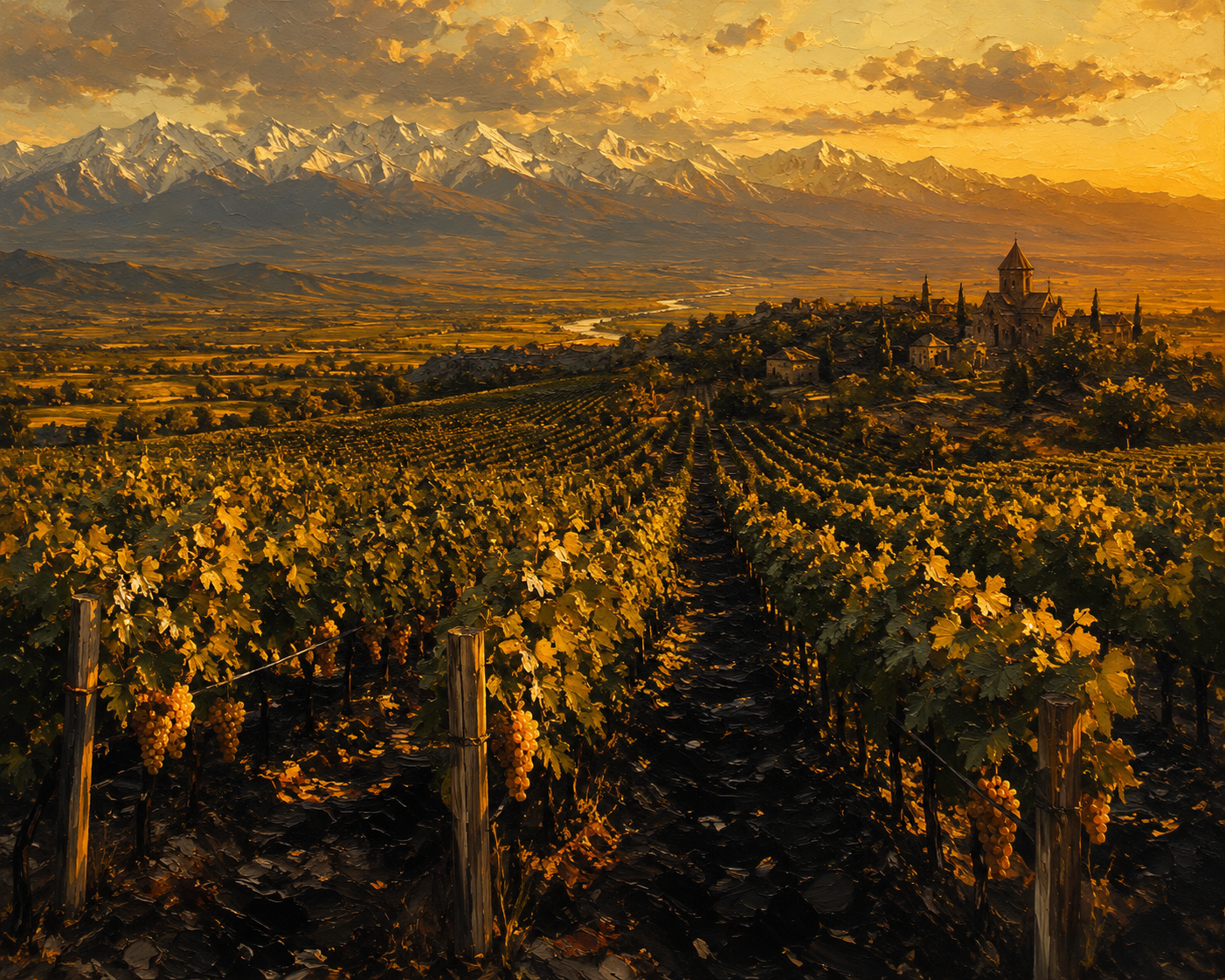
Georgia has been making wine longer than any other civilization on earth. The evidence — grape seeds, clay vessels, residue — dates to 6,000 BC in the South Caucasus. The method has not fundamentally changed. The qvevri, a large clay vessel buried in the earth, ferments and ages the wine using the temperature of the ground itself. No machinery. No additives. No technology invented in the last century that improves on what Georgian winemakers understood eight millennia ago.
Over 525 indigenous grape varieties grow in Georgia — more biodiversity in a single country than in most of Europe combined. Rkatsiteli. Saperavi. Mtsvane. Chinuri. Kisi. Khikhvi. Tsolikouri. Aleksandrouli. Names that American wine drinkers have never heard. Names that belong on the best wine lists in the country.
The gap nobody
is closing.
Here is the problem. Georgian wine is extraordinary. The natural wine movement in America has been growing for a decade, driven by exactly the kind of wine Georgia produces — low intervention, genuine terroir, a story that cannot be manufactured. The demand is there. The supply is there. The connection is not being made.
Georgian producers do not know how to navigate the American three-tier distribution system. They do not know which importers to approach, how to price for the US market, how to get TTB label approval, or how to tell their story to an American wine director in a language that lands. And American importers who are actively looking for the next undiscovered region do not have someone on the ground in Tbilisi who can find the right producers and make a credible introduction.
That is the gap. It is specific. It is solvable. And almost no one is working on it.
Why Eastbound.
Why now.
In July 2026, Nick Russell relocated to Tbilisi. Not for a research trip. Not for a wine tour. He moved — with the intention of doing what Jason did, in a different century, for a different kind of treasure.
He speaks Georgian. He is in the wine bars, in the cellars, in the Kakheti valley. He is building relationships with producers who make wine the way it has always been made in Georgia — naturally, in qvevri, with grapes that have no equivalent anywhere else on earth. And he is bringing those producers to the attention of American importers who are ready for exactly what Georgia offers.
The Golden Fleece is still there. The treasure the Argonauts found in Colchis is still being made, by families who have been making it for generations, in a country most Americans have never visited. Eastbound exists to change that — one producer, one importer, one introduction at a time.
America's turn is now.
Ready to be part of it?
Georgian winemaker or American importer — we want to hear from you.
Start a Conversation →